

Fire extinguishers are the kind of equipment everyone hopes they never have to use, and for the most part, they don’t. But that’s exactly what makes them easy to overlook. In industrial settings, an industrial fire extinguisher cover is often the last thing on the procurement checklist, yet these units spend the overwhelming majority of their service life sitting in their environment rather than responding to emergencies, and every hour of that exposure shapes whether the unit actually performs when it needs to, whether that’s in a real fire or in front of an inspector.
Inspecting more than 25,000 extinguishers across Western Canada has given us some pretty reliable insights into what affects their condition over time. One look at the unit and we can usually tell whether a weatherproof fire extinguisher cover was part of their protection arsenal.
Condition Changes Gradually. Inspections Simply Record the Outcome.
Before getting into the specifics of cover selection, it’s worth understanding what these units are actually up against. Think about the environments where extinguishers typically live. Service trucks, processing facility walls, pieces of heavy equipment, outdoor storage racks, all of them spending thousands of hours baking in the sun, fighting moisture, or absorbing continuous vibration as part of daily operation. NFPA 10 Section 7.3.2 requires portable fire extinguishers to be maintained in a fully charged and operable condition, but that requirement applies on inspection day. The standard is less specific about the three, four, or five years of daily environmental exposure the unit accumulates between each visit.
An industrial fire extinguisher cover puts a protective layer between the unit and that daily reality. For facilities and fleets running dozens or hundreds of extinguishers, that protection produces more consistent inspection outcomes, fewer condition-related deficiencies, and a maintenance cycle that runs more predictably from one year to the next.
NFPA Compliant Fire Extinguisher Protection Requires Visibility, Not Just Coverage
Something that doesn’t always get enough attention when people think about extinguisher covers is that NFPA compliant fire extinguisher protection addresses accessibility just as much as physical protection. NFPA 10 Section 7.2.2 specifies that during monthly inspections:
- the extinguisher must be in its designated location with no obstruction to access or visibility,
- operating instructions facing outward and legible, and
- no obvious physical damage or condition deficiencies present.
A cover that compromises any of those requirements creates a compliance problem rather than solving one. The better-designed covers treat inspection access as a build requirement from the start, so the gauge can be read, the operating information reviewed, and the unit assessed without fully removing the cover each time. In operations managing large inventories across multiple sites, any added step per unit compounds quickly when inspection frequency is high. The right NFPA compliant fire extinguisher protection solution makes compliance easier to maintain, not more complicated.
What Makes AR Fire Equipment’s Heavy Duty Fire Extinguisher Cover Different
Not all extinguisher installations face the same conditions, and not all covers are built to match them. A warehouse unit has a fairly controlled life, but the same unit on a service truck running gravel roads, sitting outdoors overnight, and absorbing field vibration through every shift is a completely different story. Agricultural operations add fertilizer compounds and airborne chemicals to that picture. Resource-sector sites introduce industrial fluids and sustained vibration. These environments separate a cover that performs from one that simply fits.
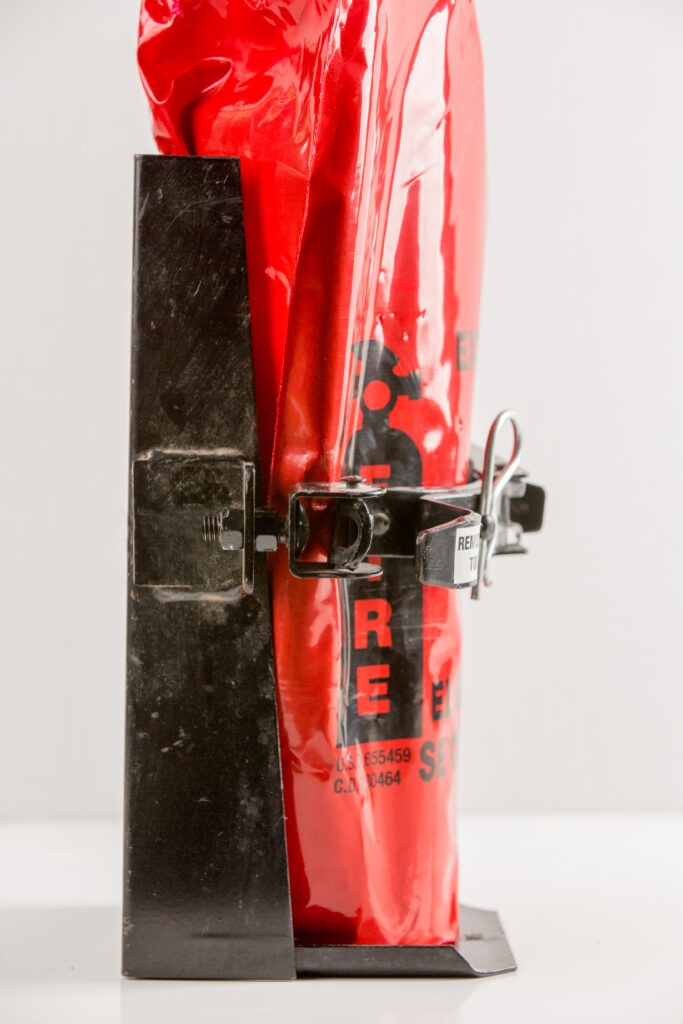
AR Fire Equipment’s heavy duty fire extinguisher cover is built from UV-rated copolymer material, the same class used in industrial equipment housings designed for outdoor exposure. UV-rated copolymer maintains structural integrity under sustained UV load rather than just resisting surface fading, which matters when a cover spends years mounted outdoors across Canadian summers and winters alike. The chemical resistance handles the fertilizer compounds, road treatment chemicals, and industrial fluids that standard covers aren’t rated for. And the construction holds secure across freeze-thaw cycles without the brittleness that affects lower-grade materials when temperatures drop hard. Get the spec right and the cover just works, season after season, without appearing in the inspection record as something to manage.
The Season-by-Season Case for a Weatherproof Fire Extinguisher Cover
Most industrial operators manage extinguisher programs around annual inspection intervals, which is the right approach. What that framework doesn’t automatically capture is what a Canadian operating season actually does to an unprotected unit.
Spring thaw combines moisture cycling with peak road spray. Summer at northern latitudes delivers UV load that runs longer than lower-latitude product ratings reflect. Autumn marks the start of freeze-thaw cycling that continues through winter, each cycle working on seals, labels, and cylinder surfaces in ways that accumulate quietly across years of service. By the time the annual inspection arrives, the extinguisher has already run a full gauntlet.
AR Fire Equipment’s weatherproof fire extinguisher cover is built to take that gauntlet on instead. Available for warehouses, job sites, vehicles, and outdoor installations across Canada, with a bulk discount on orders of ten or more, it’s a straightforward investment that consistently shows up in better inspection outcomes across fleets that use it. After 25,000 inspections, the pattern is reliable enough that we look for the cover before we even look at the unit.
Explore AR Fire Equipment’s range of weatherproof, heavy-duty fire extinguisher cover solutions. sales@arfireequipment.com | +1 (403) 815-9527
FAQs
1. Why use a weatherproof fire extinguisher cover?
A weatherproof fire extinguisher cover helps protect extinguishers from moisture, UV exposure, dirt, chemicals, and other environmental factors that can contribute to premature wear and inspection deficiencies.
2. Are fire extinguisher covers NFPA compliant?
Yes, provided the cover does not obstruct access, visibility, or required inspection information. NFPA compliant fire extinguisher protection should allow inspectors to verify the extinguisher’s condition and accessibility.
3. Where are heavy-duty fire extinguisher covers commonly used?
Heavy-duty fire extinguisher covers are commonly used on service vehicles, construction sites, industrial facilities, agricultural equipment, warehouses, and other demanding environments where extinguishers are exposed to the elements.
4. What features should I look for in an industrial fire extinguisher cover?
Look for UV-resistant materials, chemical resistance, durable construction, secure mounting, and a design that supports quick access and routine inspections.