

Walk a job site in July and you already know how hot steel gets sitting in the sun all day. A dark extinguisher cylinder strapped to a fuel truck or hanging on an outdoor rack isn’t just “warm,” it can climb past 70°C on a 30°C Calgary afternoon, the difference between an extinguisher that’s fine and one that’s quietly cooking itself.
And here’s the part that bothers me. Most safety managers check the gauge, see the needle sitting in the green, and move on with their day. Reasonable thing to do, and in a specific, infuriating way, not enough. Real outdoor fire extinguisher protection has to account for a lot more than what that needle shows.
What the Sun Is Doing to the Powder
The dry chemical inside a standard ABC extinguisher, usually monoammonium phosphate, is hygroscopic. It grabs moisture out of the air the way a box of salt does in a humid kitchen. Manufacturers coat every particle in silicone to stop this, and it works, right up until moisture gets past the seal, at which point the coating is fighting a battle it’s already lost.
That’s the real story, and it starts with UV cooking the rubber gaskets and O-rings at the top of the cylinder, the very thing a UV resistant fire extinguisher cover blocks. Give it a summer or two and those seals go stiff and crack at the edges, an open door for what comes next. Every hot afternoon and cool night after that, the cylinder breathes in and out, pulling a little more humid air past the seal, until the powder stops being powder and becomes a solid lump.
Why the Gauge Won’t Tell You Any of This
You can inspect an extinguisher that’s spent three summers baking on a truck, see a clean needle sitting right in the green, and be looking at a useless piece of equipment. The gauge measures the nitrogen sitting above the powder, and that’s all it was ever built to do. It has no opinion on whether the powder underneath is a fine mist or a solid brick.
This is the split worth keeping straight, what you’re checking versus what you’re not.
| What a visual gauge check confirms | What it can’t detect |
| Propellant gas pressure | Whether the powder has caked |
| Needle position in the green zone | Moisture that’s already past the seals |
| Obvious external damage or corrosion | Brittleness in seals that haven’t visibly cracked yet |
| Pin and tamper seal condition | Whether the unit will discharge at all |
Temperature makes this worse in a second way. Gases expand when hot and contract when cold, full stop. A cylinder baking in July shows higher pressure, one freezing in January shows lower, and neither has anything to do with an actual leak. Your team can pull a good extinguisher for recharge just because it’s hot outside, or a slow leak can hide behind a reading temperature happens to be propping up. An extreme temperature fire extinguisher cover exists because that swing is real.
Industrial Fire Extinguisher Protection and the Compliance Angle Nobody Loves Talking About
NFPA 10 Section 6.1.3.7 requires extinguishers to be protected from physical and environmental damage, and OSHA’s 29 CFR 1910.157 leans on the same idea. But here’s what gets missed. A visual inspection was never designed to catch caked powder behind a sealed cylinder, that’s outside the scope of what a gauge check can tell anyone. Industrial fire extinguisher protection has to happen before the inspection, because by the time someone’s standing there with a clipboard, the damage is already invisible.
We’ve reviewed more than 25,000 extinguishers across Western Canada, and caked powder behind a normal-looking gauge shows up over and over in units left exposed with no cover and no drainage at the base. It’s part of something bigger too. Roughly 100,000 fire extinguishers get replaced weekly across North America from rust and corrosion alone, decades before their rated 30-year life is up. That number is basically why AR Fire Equipment Innovations Inc. exists.
Where Prevention Has to Happen
I’ll be honest, a cover isn’t a magic fix. Slap one on an extinguisher and never think about it again, and you’ve just made the problem harder to notice, not solved. A good cover buys the seals time, blocking the UV that dries them out and the heat that accelerates everything else. That’s the whole game, protect the part that fails first.
We spent years watching people buy the cheapest vinyl cover from a big-box supplier, only to watch it split at the seams after one Western Canadian winter, a split cover funneling rain and snow straight onto a cylinder that used to at least dry out on its own.
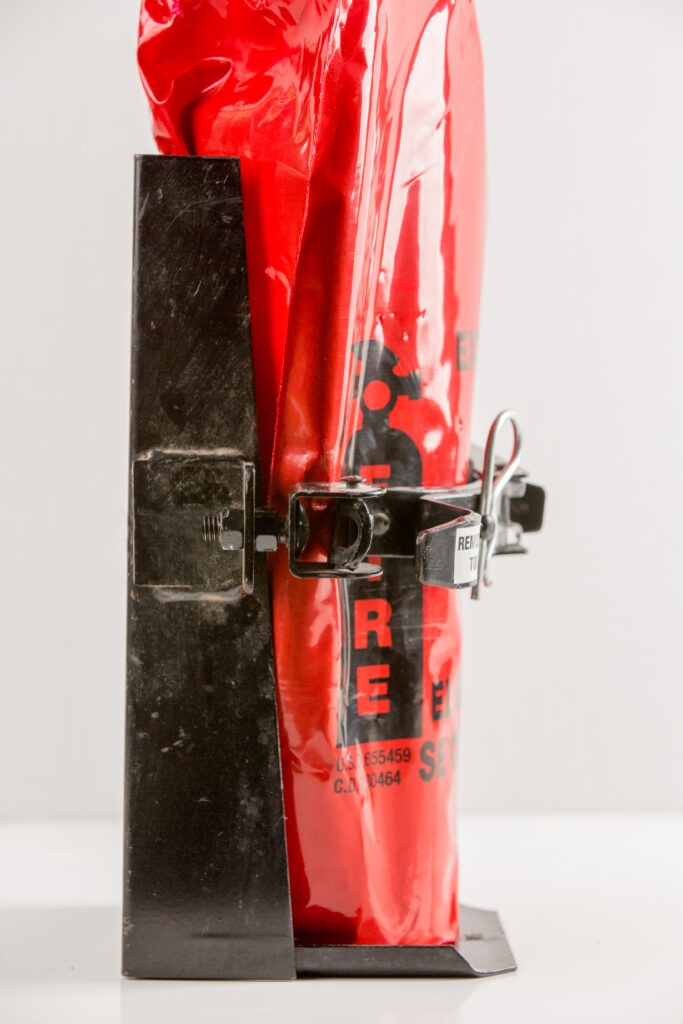
A UV resistant fire extinguisher cover needs to survive the conditions it’s protecting against, not just look the part in a photo. AR Fire Equipment’s covers are built from a patented copolymer with a two-year UV rating — double the standard vinyl — while the Caddy housing carries a seven-year rating for long-term fixed installations., made for the gap between a Calgary summer and a northern Alberta winter. Weather resistant extinguisher storage has to work at both ends of that range.
If your extinguishers are sitting exposed on a job site right now, browse our fire extinguisher covers and caddies built for outdoor fire extinguisher protection in these conditions, or talk to our Calgary team about a fleet.
For more on how a weatherproof cover keeps a system inspection-ready, read our post on What Is a Weatherproof Industrial Fire Extinguisher Cover and How Does It Keep You NFPA Compliant?
FAQs
Can a fire extinguisher look fine on inspection and still fail to work? Yes, more often than people expect. A normal gauge reading only confirms propellant pressure, not whether the powder inside has caked, which can block discharge even with a normal-looking gauge.
How does moisture get inside a sealed fire extinguisher? Through gaskets and O-rings that lose their elasticity from sun and temperature swings. Once a seal dries out, humid air gets in through gaps too small to see.
Does cold winter weather cause the same caking problem as summer heat? Not on its own, but seals already cracked from a summer of sun don’t fix themselves in winter. They stay just as vulnerable, and melting snow gets in the same way humidity did in July.
Are protective covers required by safety codes? Yes. NFPA 10 Section 6.1.3.7 and OSHA’s 29 CFR 1910.157 both require extinguishers exposed to direct sun or harsh weather to be protected by a suitable cover or enclosure.